


Hair loss is one of the most common hair and scalp concerns affecting both men and women. Thinning hair, receding hairlines, excessive hair fall, weak hair follicles, and reduced hair density can affect confidence and overall appearance. With advances in hair restoration, treatments such as GFC therapy for hair, GFC hair treatment, and other regenerative hair therapies are becoming popular options for people looking for non-surgical approaches to improve hair and scalp health .At Hair Roots Transplant Center, Meerut, patients can consult qualified hair restoration professionals to understand whether GFC therapy for hair loss is suitable for their individual condition.
What Is GFC Therapy for Hair?
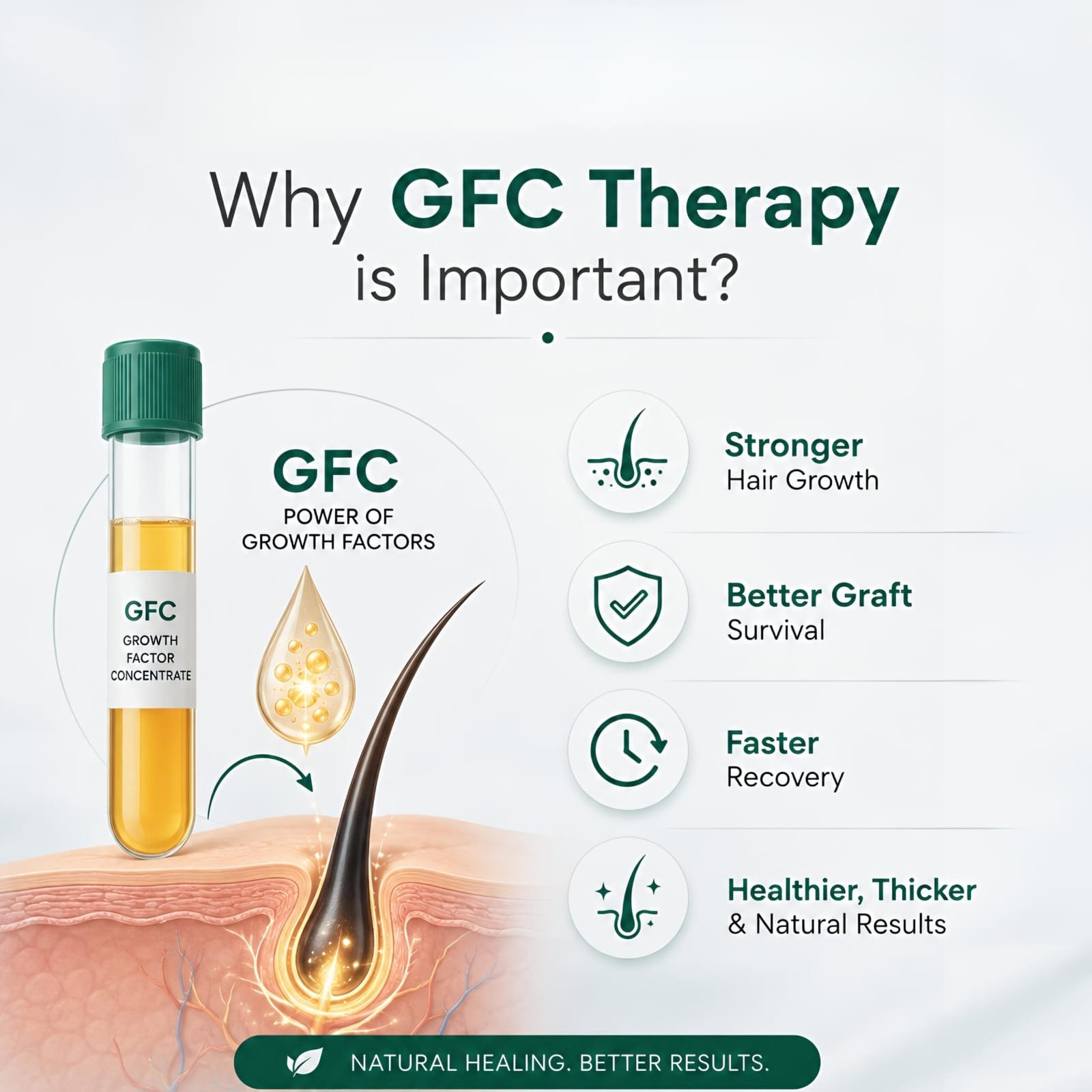
GFC therapy, commonly referred to as Growth Factor Concentrate therapy, is a regenerative treatment used in hair restoration. The treatment uses growth-factor-rich components prepared from the patient’s own blood. These growth factors are intended to support the scalp environment and may help improve the function of weakened hair follicles.GFC hair treatment is different from a conventional hair transplant because it is a non-surgical hair restoration procedure. It does not involve transplanting hair follicles from one part of the scalp to another.The suitability of GFC therapy depends on factors such as the cause of hair loss, stage of hair thinning, follicle condition, age, medical history, and scalp health.
How Does GFC Hair Treatment Work?
GFC treatment for hair generally involves collecting a small amount of the patient’s blood and processing it to obtain a concentrated preparation containing growth factors.
A typical GFC hair therapy procedure may include:
- Consultation and scalp assessment
The doctor evaluates the pattern and severity of hair loss. - Blood sample collection
A small blood sample is collected from the patient. - Preparation of growth-factor concentrate
The sample is processed using a controlled technique to obtain a growth-factor-rich concentrate. - Scalp preparation
The treatment area is cleaned and prepared. - GFC application/injection
The prepared concentrate is administered into selected areas of the scalp. - Post-treatment care
Patients receive instructions regarding scalp care and follow-up appointments.
The exact protocol can vary according to the patient’s hair-loss condition and the treating doctor’s assessment.
Benefits of GFC Therapy for Hair Loss
People searching for GFC treatment for hair loss, GFC therapy for hair regrowth, or GFC hair restoration are often interested in its potential benefits.
Depending on the individual’s condition, GFC therapy may:
- Support weakened hair follicles
- Help improve the scalp environment
- Support hair thickness and density
- Be useful for certain types of early-stage hair thinning
- Provide a non-surgical treatment option
- Use biological material derived from the patient’s own blood
- Require relatively little downtime compared with surgical hair restoration
- Be used as part of a customized hair-loss management plan
It is important to understand that results are not identical for every patient. GFC therapy is not a guaranteed cure for every type of hair loss, and a proper diagnosis is important before starting treatment.
GFC Therapy vs Hair Transplant
GFC therapy and a hair transplant are different treatments.
GFC therapy is generally considered a regenerative/non-surgical approach designed to support existing hair follicles. A hair transplant, on the other hand, involves surgically moving hair follicles from a donor area to areas affected by hair loss.
GFC Therapy
- Non-surgical treatment
- Uses a patient’s own blood-derived growth-factor concentrate
- Primarily intended to support existing follicles
- May be considered for certain types of hair thinning
- Does not create a new donor supply of hair follicles
Hair Transplant
GFC Therapy for Male Hair Loss
- Surgical hair restoration procedure
- Common techniques include FUE hair transplant and DHI hair transplant
- Requires detailed evaluation of donor density and recipient areas
- Uses follicles harvested from a donor area
- Can restore hair in areas with significant follicular loss
For some patients, a doctor may recommend GFC therapy, while others may be better candidates for a hair transplant. In selected cases, regenerative treatments may also be considered as part of an overall hair-restoration plan.
Who Can Consider GFC Hair Treatment?
GFC therapy may be considered for people experiencing certain forms of:
- Hair thinning
- Early-stage hair loss
- Reduced hair density
- Weak or miniaturized hair
- Certain patterns of androgenetic alopecia
- Hair shedding associated with specific scalp conditions
However, not every patient with hair loss is an appropriate candidate for GFC therapy.
Is GFC Therapy Safe?
Hair loss can occur because of many different causes, including hereditary hair loss, nutritional deficiencies, hormonal changes, thyroid disorders, scalp conditions, stress, medications, and other medical factors. Identifying the underlying cause is therefore an important part of treatment planning.
Male pattern hair loss commonly presents as a receding hairline, thinning around the crown, or progressive reduction in hair density.
GFC therapy for male hair loss may be considered when viable hair follicles are still present. Early evaluation can be particularly important because severely miniaturized or permanently lost follicles may require a different hair-restoration strategy.
At Hair Roots Transplant Center Meerut, an individualized assessment can help determine whether GFC treatment, medication, hair transplant, or a combination approach may be more appropriate.
GFC Therapy for Female Hair Loss
GFC Treatment for Hair Regrowth: When Do Results Appear?
Women can experience hair thinning for several reasons, including genetic hair loss, hormonal changes, nutritional deficiencies, stress, and other medical conditions.
GFC therapy for female hair loss may be considered in selected cases after evaluating the underlying cause. Women with diffuse thinning should receive an appropriate assessment before choosing a hair restoration treatment.
The timeline and degree of improvement can vary depending on:
Hair growth is a gradual biological process. Patients should not expect immediate hair regrowth following GFC therapy.
- Cause of hair loss
- Stage of hair thinning
- Age
- Hair follicle condition
- Scalp health
- General health
- Treatment protocol
- Individual response to treatment
Your hair restoration specialist can explain realistic expectations after evaluating your scalp and hair-loss pattern.
Because GFC treatment uses material derived from the patient’s own blood, it is generally designed as an autologous treatment. However, as with any medical procedure involving injections, temporary effects such as discomfort, redness, swelling, or tenderness may occur.
The procedure should be performed in an appropriate clinical setting by trained professionals using proper sterile techniques.
A consultation is important to determine whether GFC therapy is appropriate for your specific condition.
GFC Therapy Cost in Meerut
The GFC therapy cost in Meerut can vary from patient to patient. There is no single price that applies to everyone because treatment plans may depend on:
- Number of sessions recommended
- Extent of hair loss
- Treatment area
- Clinical assessment
- Treatment protocol
- Follow-up requirements
- Whether GFC is combined with another hair-loss treatment
Instead of choosing a clinic based only on the lowest GFC treatment price in Meerut, patients should consider the qualifications of the treating professionals, hygiene standards, consultation process, treatment protocol, and realistic expectations.
For an accurate estimate, patients should schedule a consultation at Hair Roots Transplant Center, Meerut.
GFC Therapy in Meerut at Hair Roots Transplant Center
If you are searching for GFC therapy in Meerut, GFC treatment in Meerut, GFC hair treatment in Meerut, or GFC therapy for hair loss in Meerut, Hair Roots Transplant Center can provide a consultation-based approach to hair restoration.
The treatment plan should be customized according to your individual hair-loss pattern rather than applying the same procedure to every patient.
At Hair Roots Transplant Center, patients can discuss concerns related to:
- Hair fall
- Hair thinning
- Receding hairline
- Crown thinning
- Male pattern baldness
- Female pattern hair loss
- GFC therapy
- Hair transplant
- FUE hair transplant
- DHI hair transplant
- Scalp and hair restoration
GFC Therapy or Hair Transplant: Which Is Better?
There is no universal answer to whether GFC therapy or a hair transplant is better.
If follicles are still present but weakened or miniaturized, a regenerative treatment may be considered depending on the diagnosis. If a patient has areas where follicles have been permanently lost and has an adequate donor supply, a hair transplant may be a more suitable option.
A professional evaluation is the best way to determine the appropriate treatment.
Why Choose Hair Roots Transplant Center Meerut?
Choosing a hair restoration center is an important decision. Patients should look for a clinic that emphasizes proper diagnosis, individualized treatment planning, transparent communication, appropriate hygiene, and realistic expectations.
Hair Roots Transplant Center, Meerut focuses on hair restoration consultations and personalized treatment planning for individuals concerned about hair loss and hair thinning.
Before undergoing any procedure, patients should discuss their medical history, current medications, expectations, possible risks, treatment alternatives, and expected outcomes with the treating professional.
Frequently Asked Questions About GFC Therapy
What is GFC therapy?
GFC therapy is a regenerative hair treatment that uses a concentrate containing growth factors derived from a patient’s own blood. It is used with the aim of supporting hair follicles and scalp health in selected cases.
Is GFC therapy a hair transplant?
No. GFC therapy and hair transplantation are different procedures. GFC therapy does not involve surgically moving hair follicles from a donor area.
Is GFC good for hair loss?
GFC may be useful for selected patients with certain types of hair thinning and hair loss. Its suitability depends on the cause and stage of hair loss.
How many GFC sessions are required?
The number and frequency of sessions vary depending on the patient’s condition and the treatment plan recommended by the hair restoration specialist.
Can GFC regrow completely bald areas?
GFC therapy should not be presented as a guaranteed method for regrowing hair in completely bald areas. Patients with significant follicular loss may need to discuss hair transplantation or other treatment options.
What is the difference between GFC and PRP?
Both are blood-derived regenerative approaches, but their preparation and concentration of growth-factor components can differ. A specialist can explain which option is appropriate based on an individual’s hair-loss condition.
Is GFC treatment permanent?
Hair loss is a complex and often progressive condition. The longevity of results can vary, and ongoing medical or hair-loss management may be recommended depending on the underlying cause.
GFC therapy for hair loss is an increasingly discussed option in regenerative hair restoration. It may be appropriate for selected patients with thinning or weakened hair follicles, but treatment should always begin with an accurate assessment of the cause of hair loss.
Final Thoughts
Book a Hair & Scalp Consultation
If you are experiencing persistent hair fall, thinning hair, receding hairline, or baldness, don’t wait until the condition progresses. A timely hair and scalp assessment can help identify the underlying problem and determine an appropriate treatment plan.
Hair Roots Transplant Center – Meerut
Specialized Hair Restoration & Hair Transplant Consultation

Leave a Reply